
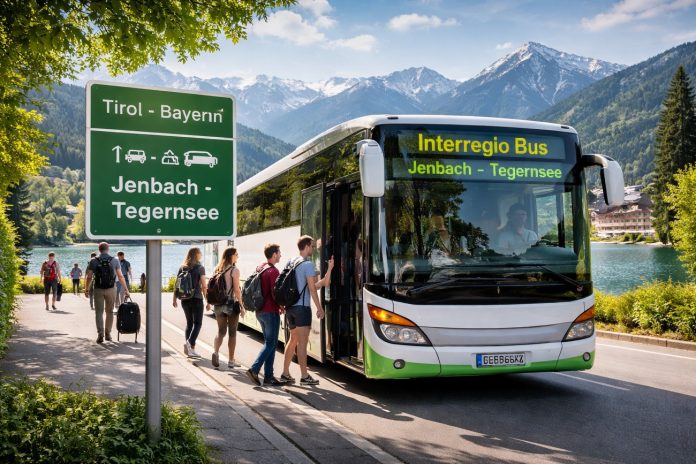
From the second half of 2027, a new hourly bus connection will link Jenbach in Tirol with Tegernsee in Bavaria. At first glance, it looks like a small regional transport upgrade. The more interesting question is why these two locations, and why now.
The answer is less about geography and more about behaviour. This corridor already functions as a cross-border zone in practice. People live on one side and work on the other. Leisure travel flows in both directions, particularly around the Tegernsee region, which has long been a destination for visitors from Austria as well as Germany. What has been missing is not demand, but a transport option that matches how the route is actually used.
Until now, the default has been the car. Not because alternatives didn’t exist at all, but because they were fragmented. Crossing the border often meant switching systems, dealing with inconsistent timetables, or simply accepting that public transport would take significantly longer. The new line addresses that directly by treating the route as a single, continuous connection rather than two separate networks.
Jenbach is not a random starting point. It is already a rail hub, connected to the wider Austrian network, including long-distance services. That makes it a natural anchor on the Tirol side. Tegernsee plays a similar role on the Bavarian side, acting as both a local centre and a destination in its own right. Connecting these two nodes effectively links broader systems, not just individual towns.
That is where the logic of the project becomes clearer. It is not designed to create new demand, but to formalise and support movement that already exists. Commuters, day travellers, and tourists are already making this journey. The difference is that from 2027, they will have a consistent, hourly alternative that does not require a car.
The funding structure also reflects this shared interest. The project is supported at multiple levels, including federal investment and contributions from Tirol and Bavaria. That matters because cross-border routes tend to fail when responsibility is unclear. In this case, the alignment of funding suggests that both sides see value in making the connection work.
What makes this more than just a local transport improvement is how representative it is of a broader shift. Mobility planning is moving away from purely national frameworks and toward functional regions. Borders still exist, but they matter less in practical terms when infrastructure is designed around actual usage patterns rather than administrative divisions.
From a practical perspective, the hourly frequency is key. This is not a symbolic connection. It is designed to be usable without planning your day around a timetable. That is the point at which public transport starts to compete with the car, not by being cheaper or more sustainable, but by being predictable.
There is also a subtle change in how these projects are framed. The emphasis is not on replacing cars outright, but on making alternatives viable enough that they become the default for certain types of journeys. Cross-border commuting and leisure travel are obvious starting points because they are already routine.
In that sense, the Tirol–Tegernsee line is less about expansion and more about alignment. It aligns infrastructure with behaviour, funding with usage, and systems with each other. None of that is particularly dramatic, but it is precisely how transport networks tend to evolve when they are working well.
The locations themselves are not the story. What matters is that they represent a corridor where demand already exists, but has been poorly served. Connecting them properly does not create something new. It simply makes an existing pattern more efficient.
And that, more than anything, explains why these two places.

