
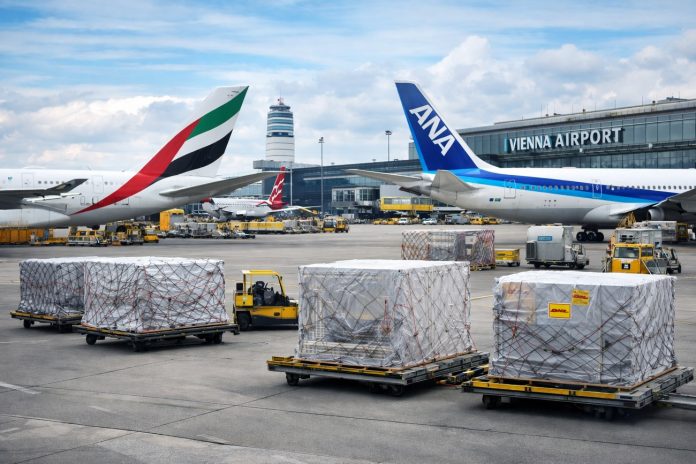
Vienna Airport handled 313,763 tonnes of cargo in 2025, passing the 300,000-tonne mark for the first time and recording year-on-year growth of 5.3%. On paper, it is a record year. In practice, the number matters less than what sits behind it.
Air cargo is rarely about volume alone. It reflects how supply chains are structured, where goods are routed, and which locations are trusted to handle time-sensitive and high-value flows. The increase in Vienna is not simply a result of more freight moving globally, but of how those flows are being organised.
One of the clearest drivers is long-haul connectivity. Additional intercontinental routes have increased belly-hold capacity, effectively expanding cargo throughput without requiring separate infrastructure. This is a familiar pattern, but in Vienna’s case it has a particular effect. The airport is not competing to be a primary global hub; it is positioned to connect global routes into a specific regional network.
That regional function becomes more visible when looking at the split between imports and exports. Imports reached 167,568 tonnes, growing by 2.8%, while exports rose more strongly by 8.4% to 146,195 tonnes. The difference is subtle but important. Vienna is not just receiving goods for local consumption. It is acting as a transfer point, feeding distribution chains that extend across Central and Eastern Europe.
E-commerce volumes, particularly from Asia, are part of this picture, but they do not explain it fully. Many airports have seen similar increases. What distinguishes Vienna is how those volumes are absorbed. Instead of creating visible strain, they appear to fit into an existing logistics structure that is already oriented toward redistribution rather than end delivery.
The pharmaceutical segment reinforces that positioning. The Vienna Pharma Handling Center recorded growth of 6.4%, reflecting sustained demand for temperature-controlled and time-critical shipments. This is a different category of cargo entirely. It requires infrastructure that can maintain strict conditions and processes that minimise variability. Growth in this segment suggests that Vienna is being used not just for capacity, but for reliability.
There is a tendency to associate cargo growth with scale, but in practice it often reflects trust. Supply chains route through locations that can deliver consistency. A 24/7 operating model, combined with dedicated cargo facilities, reduces uncertainty in a system where timing is critical. That becomes particularly relevant when goods are moving across multiple jurisdictions, each with its own constraints.
What emerges is a clearer picture of Vienna’s role. It is not a primary origin or destination in the global sense. It sits between them, acting as a point where flows are consolidated, redirected, and distributed. That position is less visible than being a major hub, but it can be just as influential.
From a practical perspective, this kind of growth tends to be incremental. There is no single moment where the system changes. Instead, routes are added, volumes increase, and certain types of cargo begin to concentrate. Over time, those adjustments shift how an airport is used.
The statement from Vienna Airport’s CEO that cargo is a key success factor reflects this underlying dynamic. Air freight supports supply chains, but it also reveals them. When volumes increase in a location like Vienna, it suggests that the surrounding network is becoming more integrated and more dependent on that point of connection.
The broader context is one of ongoing adjustment in global trade. Supply chains are being rebalanced, with more emphasis on resilience and flexibility. Secondary hubs and regional gateways are becoming more important as companies look to avoid over-reliance on a small number of major nodes. Vienna fits into that shift, not as a replacement for larger hubs, but as a complement to them.
The record figure, then, is less a milestone than a signal. It indicates that Vienna’s role in these networks is becoming more defined. Not through sudden expansion, but through consistent use.
For most observers, the change is not immediately visible. Aircraft movements look the same, infrastructure appears unchanged, and the city itself is unaffected on the surface. But beneath that, the flows have increased, and the patterns have shifted.
Crossing 300,000 tonnes marks a threshold, but the more meaningful change lies in how those tonnes are moving, and why they are moving through Vienna at all.

