
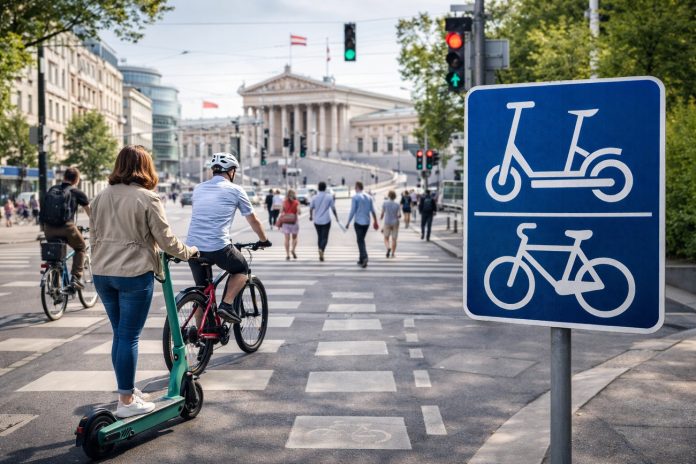
Austria’s National Council has approved a major reform of the road traffic regulations, introducing for the first time clear and unified rules for e-scooters and e-bikes. The first measures will come into force on 1 May 2026, with additional provisions expected to follow later in the year. Framed as part of a broader push toward safer and more future-ready mobility, the reform builds on previous transport and safety initiatives while addressing areas that have remained ambiguous for some time.
At a surface level, the changes are straightforward. New forms of mobility that have become common in recent years are now being formally integrated into the regulatory framework. What has been missing until now is consistency. E-scooters and e-bikes have operated in a space that was partly defined, partly assumed, and often interpreted differently depending on context. The reform replaces that ambiguity with a set of rules that are intended to apply uniformly.
That clarity is likely to matter more than any individual measure. When systems are unclear, behaviour tends to vary, and enforcement becomes uneven. Introducing consistent rules does not eliminate friction entirely, but it reduces uncertainty for both users and authorities. In practice, that tends to translate into more predictable interactions in shared spaces, particularly in urban environments where different modes of transport overlap.
What makes this reform notable is not that it introduces entirely new concepts, but that it formalises what has already been happening. E-scooters and e-bikes are no longer emerging technologies; they are part of everyday mobility. The regulatory framework is catching up with that reality rather than trying to shape it from the outset. That timing reflects a broader pattern, where adjustments are made once usage is established rather than in anticipation of it.
From a practical perspective, the emphasis on safety and modernisation suggests a shift in how mobility is being managed. The goal is not simply to accommodate new vehicles, but to integrate them into existing systems without disrupting their overall function. That requires balancing flexibility with control, allowing for different types of movement while maintaining a coherent set of rules.
There is also a subtle change in how public space is being approached. As more forms of transport share the same infrastructure, the boundaries between them become less distinct. Pedestrians, cyclists, and now users of electric micro-mobility devices operate within overlapping environments. Regulation becomes less about separation and more about coordination. The reform can be seen as an attempt to define that coordination more clearly.
At the same time, the staggered implementation indicates that this is not a one-off adjustment. Introducing initial measures in May 2026, followed by further changes in the autumn, allows for a degree of adaptation. It creates space for observing how the rules function in practice before extending or refining them. That phased approach tends to reduce the risk of unintended consequences, particularly in areas where behaviour is still evolving.
The broader context is one in which mobility is becoming more diverse, but not necessarily more complex in a visible way. For most people, the expectation remains that moving through a city should be straightforward. The challenge lies in maintaining that simplicity as the number of options increases. Clear rules are part of that, but so is how those rules are implemented and understood.
What is unlikely to change immediately is how these shifts are perceived. Regulatory updates of this kind rarely feel significant in isolation. They do not alter infrastructure overnight, nor do they transform behaviour instantly. Their impact is cumulative, shaping how systems function over time rather than in a single moment.
The reform of Austria’s road traffic regulations fits into that longer trajectory. It brings a set of already familiar modes of transport into a more defined framework, reducing ambiguity and setting expectations more clearly. The effect will not be dramatic, but it will be practical. And in the context of mobility, that is often where the most meaningful changes occur.

