
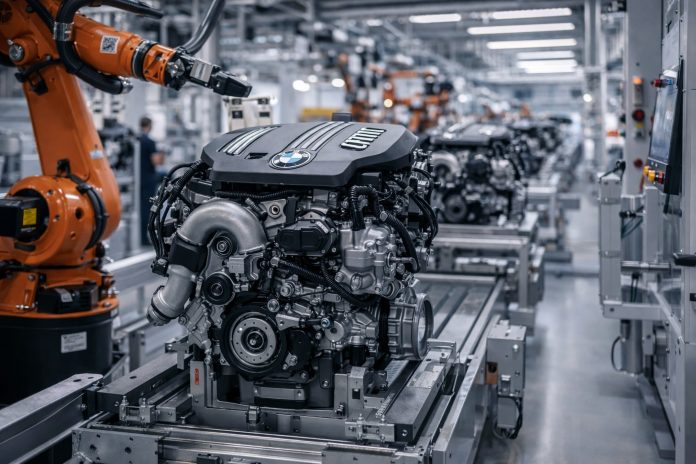
As BMW deepens its long-term mobility investment in Upper Austria, Austria’s role in Europe’s industrial transition becomes clearer. From hydrogen to electric drive systems, the country is positioning itself not as a follower of change, but as a place where legacy engineering and future technologies can coexist—and scale.
Austria has a habit of quietly placing itself at the center of big industrial shifts. It rarely shouts about it, but when you look closely, the pattern is hard to ignore. The BMW Group’s latest expansion and repositioning of its Steyr facility is one of those moments that, in hindsight, will probably be described as “obvious.”
At its Steyr site—BMW’s largest engine plant globally—the company is no longer treating combustion, electrification, and hydrogen as competing pathways. Instead, they are being developed side by side, under one industrial roof, as complementary technologies. BMW’s own success story, shared via ABA – Invest in Austria, makes the logic explicit: Austria offers engineering depth, predictable policy frameworks, serious research funding, and a technical education system that still produces people who understand how things actually work.
This matters more than it might sound.
Across Europe, mobility policy often gets trapped between ambition and implementation. Targets are announced, bans are discussed, timelines are accelerated—but the industrial reality underneath struggles to keep pace. What BMW is doing in Steyr suggests a more pragmatic route: evolve the industrial base while keeping it economically viable. That is precisely where Austria excels.
Vienna’s role: less visible, more strategic
Living in Vienna as an expat, I’m often struck by how disconnected the city’s international image can be from the industrial forces that support it. Vienna is seen—rightly—as a diplomatic hub, a livable city, a cultural capital. But its real strategic value lies in how close it sits to production, decision-making, and applied research without needing to host the factories themselves.
When a global player like BMW Group commits to long-term mobility innovation in Upper Austria, Vienna benefits indirectly but meaningfully. This is where regulatory dialogue happens, where international talent lands first, where suppliers maintain European headquarters, and where research partnerships with universities and institutes are coordinated. The city functions as the connective tissue between policy, capital, and industry.
From personal experience, this is one of Vienna’s underrated strengths. For professionals arriving from abroad, the city offers immediate access to serious industrial ecosystems without the volatility or hype found in some larger tech hubs. You can meet policymakers, engineers, and investors in the same week—and often in the same café.
Why Austria keeps attracting these investments
The question “Why Austria?” is not rhetorical. BMW answers it directly: engineering excellence, strong public research funding, high-quality technical education, and an innovation ecosystem designed for continuity rather than disruption for its own sake.
That last point matters. Austria does not force companies to reinvent themselves every political cycle. Instead, it allows long investment horizons—exactly what technologies like hydrogen fuel cells or next-generation electric drivetrains require. For companies managing global platforms, that stability is not a luxury; it is a prerequisite.
Organizations like ABA – Invest in Austria play a critical but often invisible role here. They translate Austria’s institutional complexity into something navigable for international decision-makers. That may sound administrative, but in reality, it is strategic infrastructure. Without it, many of these investments would simply go elsewhere.
A conditional optimism
None of this is guaranteed to continue by default. Austria’s advantage depends on a few conditions being actively protected: sustained R&D funding, openness to international talent, realistic mobility regulation, and continued coordination between federal, regional, and EU-level policy. If those hold, Austria—and Vienna by extension—will remain a place where the future of mobility is built, not just discussed.
From where I sit in Vienna, that future already feels less abstract than in many other European capitals. It looks industrial, incremental, and quietly confident. And that may be exactly why global players keep choosing Austria.

