
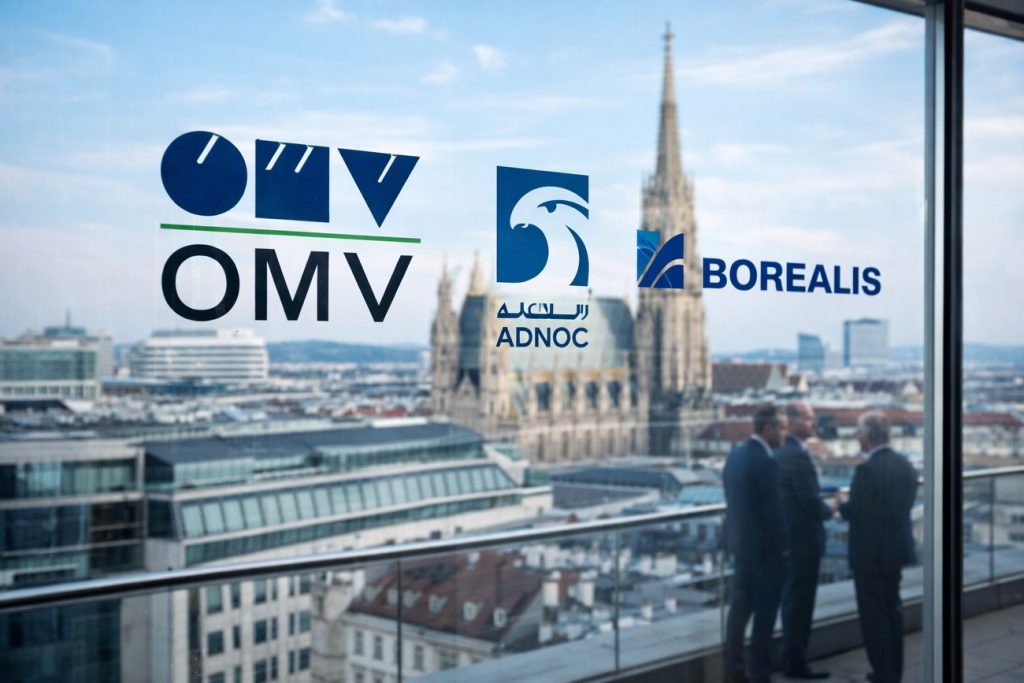
A global chemicals business worth around 60 billion US dollars is now being managed from Vienna following the merger of OMV’s and ADNOC’s chemicals divisions into Borouge International. The structure brings together Borealis, Borouge, and NOVA Chemicals under one entity, equally owned by OMV and ADNOC, and positions Vienna as the central coordination point for operations spanning Europe, the Middle East, and North America.
The scale is significant, but scale is not the most interesting part. Large chemical companies already operate globally. What changes here is control. Decisions about capital allocation, production alignment, and commercial strategy are now anchored in one place, and that place is not an obvious global chemicals hub.
Vienna’s role is not about production, and it is not about market size. It is about coordination. Borealis already provided a base, but this move consolidates something more structural. When three previously separate systems are brought together, the question is not where assets are located, but where decisions are made. That shift tends to have longer-term consequences than any individual investment.
The composition of the management team reflects the balance of the partnership. Roger Kearns, formerly CEO of NOVA Chemicals, becomes Chief Executive Officer. Stefan Doboczky of Borealis takes on the role of Chief Commercial Officer, while Dr. Hasan Karam becomes Chief Operating Officer. This is not a takeover in the traditional sense, but a deliberate integration of leadership across the three businesses.
From an industrial perspective, the merger is about alignment rather than expansion. Polyolefins are already a global market with established supply chains. The advantage of combining these companies lies in synchronising production, optimising logistics, and coordinating market access across regions that were previously connected but not unified. It is a move toward efficiency at scale rather than growth for its own sake.
What anchors this in Austria is the continued relevance of physical operations. Borealis is investing more than 100 million euros in expanding its polyolefin production site in Schwechat. That detail matters because it shows that the shift toward a global headquarters does not detach the structure from local industry. Instead, it layers strategic control on top of an existing industrial base.
There is also a broader repositioning taking place. OMV has historically been seen as a regional player with international exposure. This merger changes that perception. As CEO Alfred Stern put it, the company is now “playing on the world stage.” In practical terms, that means operating within a different set of expectations, where coordination across continents becomes routine rather than exceptional.
From a systems perspective, this kind of consolidation reflects a wider trend in the chemicals industry. Pressure is increasing from multiple directions, including cost efficiency, supply chain resilience, and the need to adapt to regulatory and sustainability demands. Larger, more integrated structures are better equipped to absorb those pressures, particularly when they can balance production and markets across regions.
What makes this development more interesting than it first appears is how quietly it fits into its surroundings. There is no visible shift in the city itself, no immediate sign of a $60 billion enterprise being coordinated locally. That tends to be how these changes manifest. The impact is not in visibility, but in influence.
Headquarters functions shape direction rather than output. They determine where investment flows, how priorities are set, and how organisations evolve over time. In that sense, the presence of Borouge International in Vienna is less about what is produced and more about how decisions are structured.
The success of the merger will depend on how effectively the three businesses are integrated. Aligning operations across regions and cultures is rarely straightforward, and the complexity increases with scale. But if that integration holds, the significance of the move will extend beyond the companies involved.
For now, what is clear is that Vienna has become the point from which a major part of the global polyolefin market is being coordinated. Not because it is the largest market or the biggest production base, but because it offers a stable platform for managing complexity.
That, more than the headline valuation, is what defines the shift.