
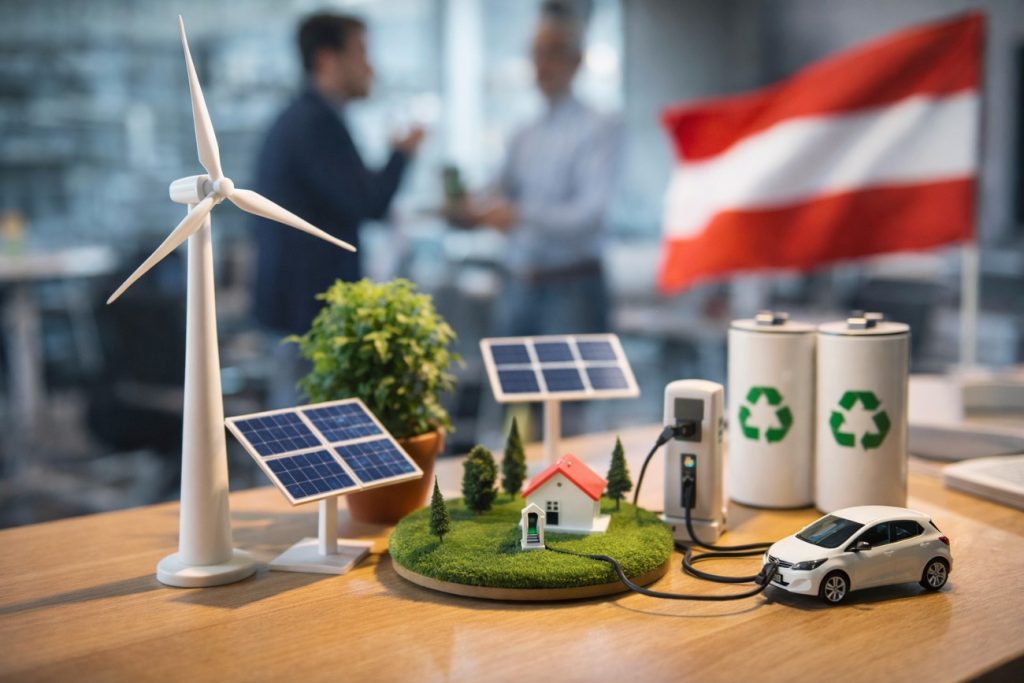
Austria’s green tech startup landscape continues to expand, but not in a way that immediately stands out. According to a recent overview by Green Tech Valley, the number and diversity of climate-focused startups in the country are increasing, spanning areas such as energy systems, circular economy solutions, and industrial decarbonisation. What is notable is not just the growth itself, but how it is taking shape.
Unlike in some larger ecosystems, where climate tech is often framed through rapid scaling and venture funding cycles, Austria’s approach appears more grounded in application. Many of the startups identified operate close to existing industries, developing solutions that integrate into established processes rather than replacing them entirely. That positioning tends to reduce visibility, but it also aligns more closely with how change is implemented in practice.
There is a certain consistency to this. Climate innovation here often emerges from a combination of engineering expertise and proximity to industrial demand. Instead of focusing on entirely new markets, companies tend to address specific inefficiencies within sectors such as manufacturing, energy distribution, and resource management. The result is a set of businesses that are less visible at the headline level, but closely tied to real-world use cases.
From a practical perspective, this makes sense. The transition to lower-emission systems is not only about new technologies, but about adapting existing infrastructure. Startups that can operate within those constraints are often better positioned to achieve adoption, even if their growth appears slower. It is a different model of innovation, one that prioritises integration over disruption.
The role of regional ecosystems is also evident. Clusters such as Green Tech Valley provide a framework that connects startups with research institutions, corporates, and public funding. That structure tends to support longer development cycles, particularly in areas where technical validation is essential. It also reflects a broader understanding that climate-related innovation often requires coordination across multiple actors rather than isolated breakthroughs.
There is, however, a tension within this model. While integration supports stability, it can also limit visibility and access to capital. Many Austrian startups still look beyond the domestic market when it comes to scaling, particularly toward larger European or international ecosystems. The challenge is not necessarily generating ideas, but accelerating their deployment.
At the same time, the broader European context is becoming more supportive. Climate policy, funding mechanisms, and regulatory frameworks are increasingly aligned toward decarbonisation goals. This creates an environment in which startups that are already focused on practical applications may find growing demand for their solutions. In that sense, Austria’s approach may be better positioned than it initially appears.
What stands out most is the absence of a single defining narrative. There is no dominant sector or flagship company that encapsulates the ecosystem. Instead, growth is distributed across multiple areas, each contributing to a broader shift. That makes the landscape harder to summarise, but also more resilient.
From an observational perspective, this kind of development tends to become visible only over time. Individual startups may not attract widespread attention, but their cumulative impact begins to shape how industries operate. Energy systems become more efficient, materials are reused more effectively, and processes are gradually adjusted.
This incremental pattern is consistent with how other parts of the economy evolve. Change is rarely driven by a single breakthrough, but by a series of smaller adjustments that accumulate. In the context of climate technology, that may be particularly relevant. Large-scale transformation often depends on the successful implementation of many smaller innovations.
Austria’s green tech startups reflect that reality. They are not necessarily redefining the narrative of climate innovation, but they are contributing to its practical execution. The emphasis is less on visibility and more on functionality, less on disruption and more on integration.
Whether this approach will translate into global leadership remains to be seen. Larger markets still offer advantages in terms of capital and scale. But as the focus shifts from experimentation to implementation, the ability to deliver workable solutions may become more important than the speed at which they are developed.
For now, Austria’s green tech ecosystem continues to grow in a way that is consistent with its broader economic model. Quietly, steadily, and closely aligned with the systems it is trying to change.