
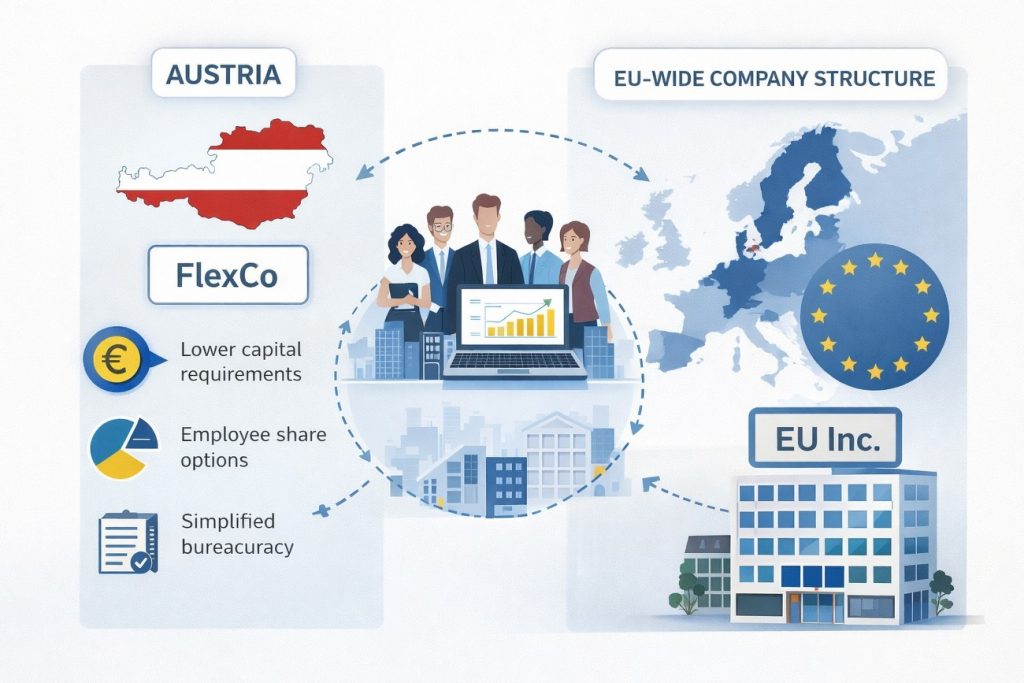
When Austria introduced the new Flexible Company (FlexCo) structure, it didn’t arrive with much noise. There were no sweeping claims about transforming the startup ecosystem overnight, and no attempt to position it as a silver bullet. Instead, it was presented in the same way many Austrian reforms are: as a practical adjustment to an existing system that needed updating. The idea, outlined by the Austrian Business Agency, was straightforward—create a company structure better suited to startups, particularly in areas like employee participation and administrative flexibility.
Living in Vienna, this kind of reform feels familiar. Change tends to be incremental and technical rather than ideological. The FlexCo is a good example of that mindset. It sits somewhere between a traditional GmbH and the needs of a modern startup, lowering minimum capital requirements, simplifying share structures, and—perhaps most importantly—making it easier to offer employees a stake in the company. The introduction of new participation models, as described in Austria’s broader startup package via the employee participation framework, addresses one of the long-standing weaknesses of the Austrian system compared to places like the UK or the US.
The question, though, is whether it has actually worked.
So far, the answer appears to be cautiously positive, but not transformative. The FlexCo has removed some friction, particularly for early-stage companies that want to align incentives between founders and employees. It has also made Austria more legible to international investors who are used to more flexible equity structures. But it hasn’t fundamentally changed the dynamics of the ecosystem. Startups are still influenced by access to capital, market size, and scaling pathways, all of which extend beyond legal form.
From what I’ve observed, the real impact of the FlexCo is less about volume and more about signalling. It tells founders that Austria understands where the friction points are, and that it is willing to adjust. That matters, especially in a country where legal and administrative frameworks have traditionally been seen as rigid. At the same time, the reform fits neatly into Austria’s broader pattern: improve the system quietly, without overpromising outcomes.
There is also a wider context that makes the FlexCo particularly interesting. Across Europe, there has been growing discussion about the need for a more unified company structure that would allow startups to operate seamlessly across borders. The fragmentation of legal systems remains one of the EU’s structural disadvantages compared to the United States. Each country offers its own version of a startup-friendly entity, but none of them translate easily across jurisdictions.
This is where the idea of an EU-wide company structure comes in. The European Commission has been exploring options for harmonising corporate frameworks, particularly for innovative companies that need to scale quickly across member states. While existing forms like the Societas Europaea (SE) provide a legal basis for cross-border operations, they are often too complex or costly for startups. The direction of travel, as indicated in various EU policy discussions, is toward something simpler, more standardised, and better aligned with the needs of high-growth companies.
Austria’s FlexCo can be seen as part of that broader movement. It is not an EU-wide solution, but it moves the national framework closer to what a harmonised European model might look like. In that sense, its significance may lie less in its domestic uptake and more in how it positions Austria within a future integrated market.
From a practical perspective, living and working in Vienna, the change is not something you feel day to day. There is no visible shift in the streets or in the way businesses operate at a surface level. But beneath that, there is a gradual alignment taking place between Austria’s legal infrastructure and the realities of modern startups. That alignment tends to happen quietly here, without the sense of disruption that often accompanies reform elsewhere.
Whether the FlexCo will be remembered as a turning point is still unclear. It may end up being one step in a longer process of adaptation rather than a defining moment in itself. But in a European context where harmonisation is increasingly necessary, even small steps matter. Austria has adjusted its framework in a way that reduces friction and improves compatibility with international norms.
That alone does not create a startup ecosystem, but it does remove one of the reasons founders might choose to build elsewhere. And in a system like Austria’s, where stability is valued as much as innovation, that may be exactly the point.