
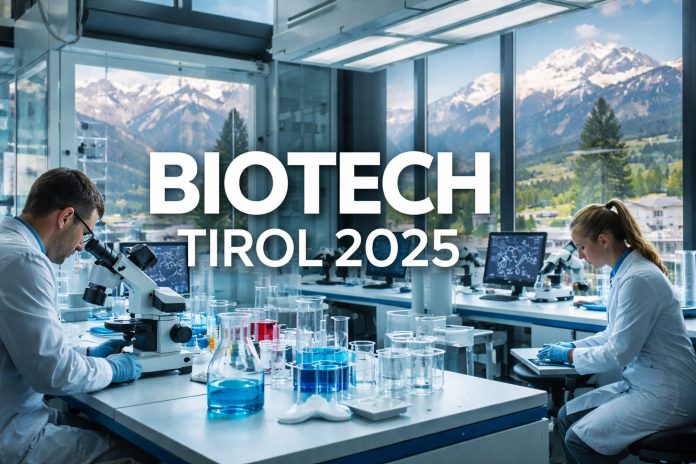
Over the past few years, Tirol has quietly but decisively repositioned itself as one of Austria’s most credible life sciences regions. The opening of the Health Hub Tirol in Innsbruck’s West Park marked more than a real-estate milestone; it signals a long-term political and economic commitment to biotechnology, medtech, and applied life sciences as strategic growth pillars for the region. Backed by roughly €10 million in recent investments, the hub provides something Austria has often lacked outside Vienna: a clearly branded, internationally legible focal point for innovation.
This positioning was reinforced at the European Forum Alpbach, where Tirol used the Euregio Days to frame life sciences and digitalisation as inseparable drivers of future competitiveness. What stood out to me—having observed the Biomedical industry in Austria for years—is how confidently Tirol now speaks the language of cross-border collaboration.
That confidence is not unfounded. As highlighted during the 21st Technology Brunch in Alpbach, Tirol’s life sciences sector already accounts for more than 10,000 jobs and close to €4 billion in turnover. These are no longer “promising” figures; they represent an established industrial base. The Health Hub Tirol, positioned as a lighthouse project, could help ensure that this base continues to translate research excellence into scalable commercial outcomes.
The strength of the ecosystem becomes tangible when looking at individual companies. Stories like KinCon biolabs, which is pushing real-time cellular observation in drug development, illustrate how deeply embedded scientific innovation is within the region. Even more striking is the international validation seen in Cyprumed’s licensing deal with MSD (Merck & Co.)—a $500 million agreement that places an Innsbruck-based biotech firmly on the global pharmaceutical map.
Equally important is the ecosystem layer around these successes. Events such as the Life Sciences Partnering 2025 underline a shared understanding that networks, trust, and continuity matter just as much as funding. Austria has strong research institutions, but too often they operate in parallel rather than in concert. Tirol’s approach—actively curating encounters between science, startups, and industry—feels refreshingly pragmatic.
For Austria as a whole, Biotech Tirol offers a useful blueprint. National competitiveness in life sciences will not come from a single dominant hub, but from several specialised regions that are internationally connected and locally anchored. Continued support through instruments like the Health Hub Tirol funding programme and initiatives such as aws Best of Biotech will be essential. If policymakers can maintain funding stability and resist short-termism, Tirol’s biotech story could become one of Austria’s strongest economic narratives of the decade. I’m looking forward to seeing what 2026 brings for Tirol.

