
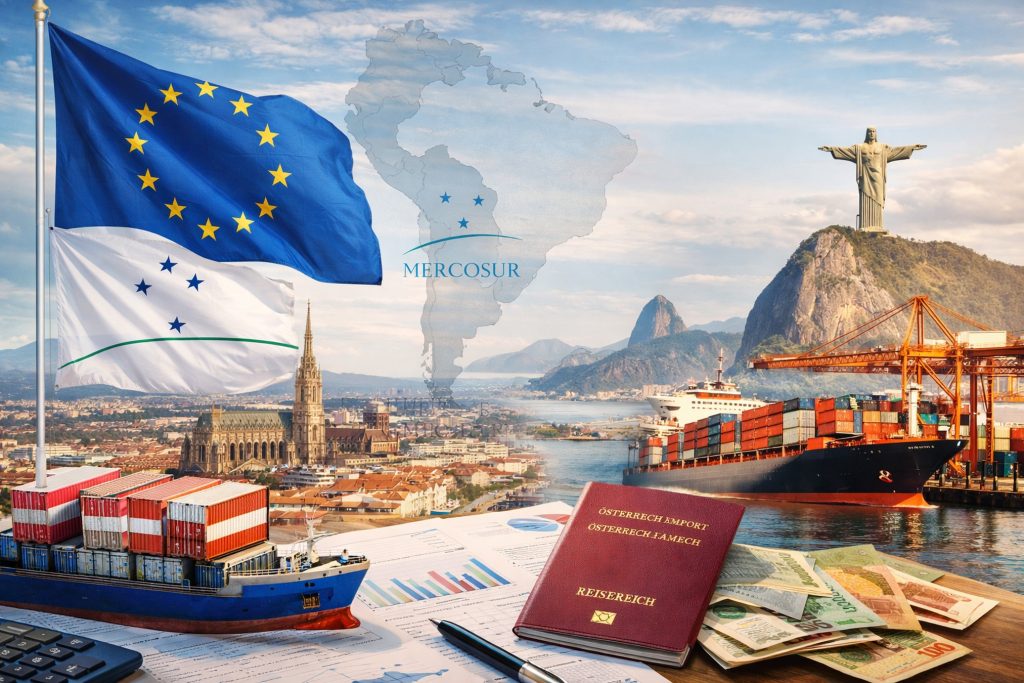
Over the years, after spending so much time here in Vienna, I’ve come to realise how closely Austria’s economic outlook is tied to decisions made far beyond its borders. Trade policy may feel distant or technical, but in a country as export-driven as Austria, these agreements shape real outcomes for companies, workers, and long-term competitiveness. That’s why the recent signing of the EU–Mercosur trade agreement struck me as more than just another Brussels headline.
With the agreement now signed, the European Union has taken a decisive step towards strengthening its trade relationship with South America at a time of heightened geopolitical uncertainty and growing global trade tensions. According to Außenwirtschaft Austria, the deal represents a strategic milestone for Europe’s external trade policy, reinforcing economic ties with Mercosur countries when supply-chain diversification has become a necessity rather than a choice. Further context on the agreement and its implications is outlined in this source article: https://bit.ly/4pDFBzt.
What resonated with me most was the emphasis on what comes next. WKÖ President Martha Schultz has highlighted that rapid ratification will be crucial if businesses are to benefit in practice. From my own experience working across different European markets, delays in implementation often dilute the value of trade agreements—especially for smaller companies that don’t have the resources to navigate prolonged uncertainty.
Small and medium-sized enterprises stand to gain the most from reduced tariffs, lower bureaucratic hurdles, and simplified market access. These are not abstract advantages. Anyone who has tried to export beyond Europe knows that administrative complexity can quickly become a deal-breaker. Lowering those barriers opens real opportunities, particularly for Austrian SMEs that already compete on quality, reliability, and specialised expertise.
The economic potential is significant. According to analyses by the International Trade Center, Austria’s additional export potential in the Mercosur region exceeds €1 billion. That figure reflects concrete opportunities in sectors where Austria is already strong—machinery, industrial components, environmental technologies, and specialised manufacturing. From an outsider’s perspective living in Vienna, it’s clear that South America represents a natural extension for Austrian exporters rather than an unfamiliar frontier.
What I also find encouraging is Austria’s proactive support structure. Through Außenwirtschaft Austria and its centres in São Paulo and Buenos Aires, companies are not left to navigate these markets alone. This combination of trade diplomacy and practical, on-the-ground assistance is something Austria does particularly well, and it often goes unnoticed outside business circles.
For me, the EU–Mercosur agreement is less about short-term gains and more about long-term positioning. In a global environment where protectionism is becoming louder, Europe’s willingness to deepen international trade partnerships feels both pragmatic and quietly confident. Watching this from Vienna, it reinforces why Austria continues to punch above its weight in global trade—not through volume, but through strategy, specialisation, and consistency.
The agreement won’t solve every challenge overnight, but it does create a framework for growth at a moment when diversification matters. As an expat here, it’s reassuring to see Austria remain outward-looking, measured, and firmly committed to global economic engagement—even when the world feels increasingly fragmented.