
When you live in Vienna as an expat, you know that the city doesn’t treat infrastructure as a technical afterthought. It treats it as a statement about how people should live together. That’s why the opening of the U2 station Lina-Loos-Platz on 19 January 2026 feels like more than just a transport milestone. It is Vienna’s 110th underground station, and in many ways, it reflects how deliberately the city thinks about growth.
According to Wiener Linien, the new station sits between Aspernstraße and Hausfeldstraße, extending the U2 to 21 stations and strengthening public transport access in Donaustadt, one of Vienna’s fastest-growing districts. For the nearby urban development area Oberes Hausfeld, this matters enormously. Around 3,700 new homes, along with schools, workplaces, leisure facilities, and green spaces, are planned across roughly 26 hectares—designed for around 8,000 future residents. What stands out is that the neighbourhood is connected to the public transport network from day one, not retrofitted years later.
From a practical perspective, this is classic Vienna. The station’s shell was already built during the U2 extension to Seestadt in 2013, with full construction continuing from 2021—while trains kept running. That kind of long-term planning is easy to underestimate until you’ve lived somewhere where infrastructure is constantly playing catch-up. Here, continuity is the strategy.
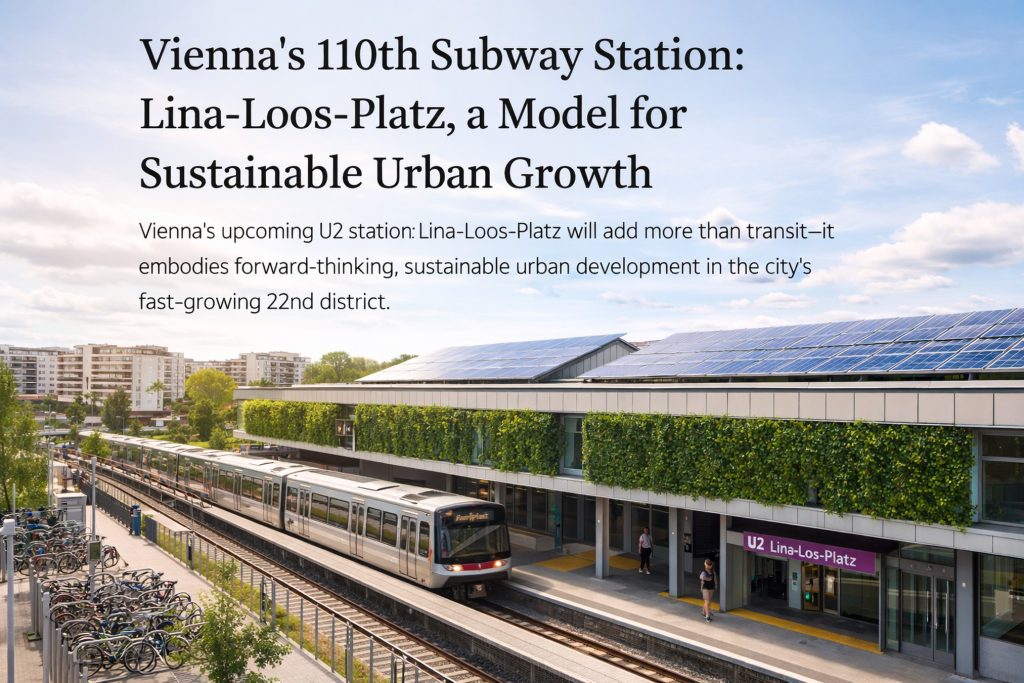
What also deserves attention is how sustainability has been integrated into the station itself. The Lina-Loos-Platz station features photovoltaic panels on the roof, green façades, two bicycle garages, and step-free access via new lifts. More than 70 solar modules generate clean energy, while the planted exterior improves the local microclimate. These aren’t headline-grabbing innovations, but they add up—and that’s the point. Vienna tends to pursue climate goals incrementally, embedding them into everyday systems rather than isolating them as showcase projects.
The surrounding Lina-Loos-Platz will evolve into a small urban oasis over the coming years, with more than 50 new trees, water features, seating areas, and permeable surfaces that allow rainwater to seep naturally into the ground. In a city increasingly shaped by hotter summers, this kind of climate-adaptive design feels not just sensible, but necessary.
There is also something quietly symbolic about the station’s name. Lina-Loos-Platz honours Lina Loos—a writer, actress, feminist pioneer, and peace activist who challenged the social conventions of her time. In a city where, as an analysis by the European Data Journalism Network showed, roughly 90% of streets are named after men, the decision to name both a public square and a U-Bahn station after a woman like Lina Loos is more than a gesture. It reflects a conscious effort by the City of Vienna to rebalance how history is represented in public space—something also visible in developments such as Seestadt Aspern, where new streets are named exclusively after women.
As someone who didn’t grow up here, I find this combination of practicality and values striking. Vienna’s infrastructure projects rarely shout about ideology, yet they consistently encode it: accessibility, environmental responsibility, historical awareness, and social balance. The Lina-Loos-Platz station doesn’t just move people more efficiently. It reinforces the idea that growth can be planned, inclusive, and climate-conscious—if the political will exists to think beyond election cycles.
For Vienna, the real opportunity lies in continuing this approach as the city expands. If future developments maintain the same commitment to public transport-first planning, green infrastructure, and symbolic representation, the city will remain not just liveable, but resilient. As an expat watching Vienna evolve from the inside, the opening of its 110th U-Bahn station feels less like an endpoint—and more like a quiet confirmation that the city still knows where it wants to go.