
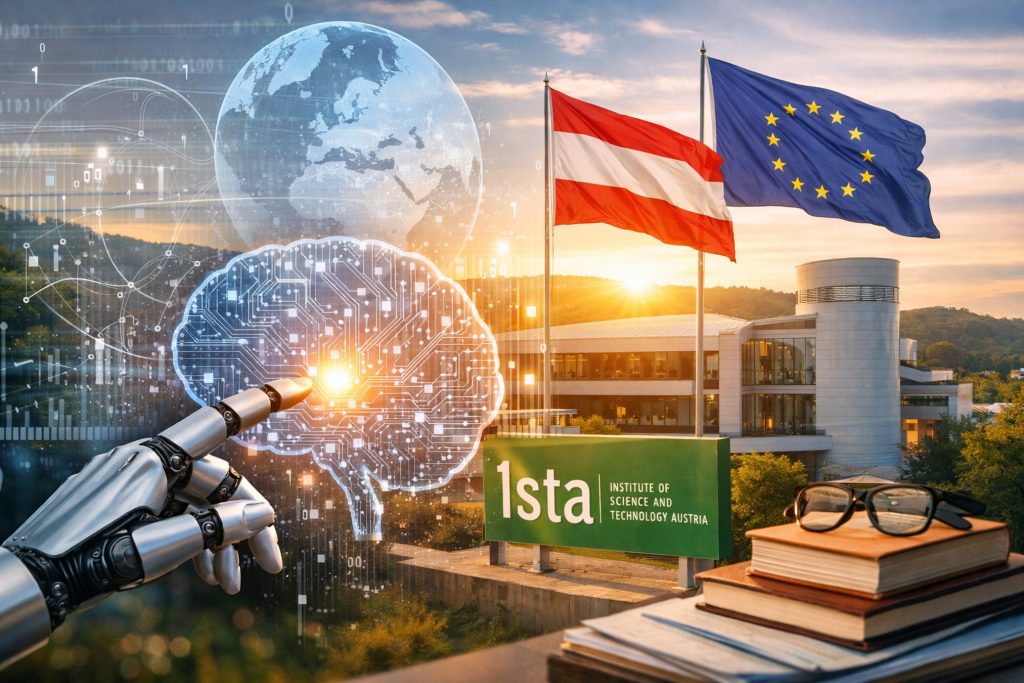
Living in Vienna as an expat, you quickly learn that this city doesn’t shout about innovation—it proves it quietly, over time. That’s why the recent news that the Institute of Science and Technology Austria (ISTA) has received a €5 million donation for AI research genuinely caught my attention. The funding comes from Uber co-founder Garrett Camp, and notably, it marks his first-ever contribution to a European research institution, according to ISTA’s own announcement published here.
The size of the donation matters, of course—but the intent behind it matters even more. Camp’s support is aimed at advancing artificial intelligence as a trustworthy, human-centered technology, one designed to benefit society rather than simply accelerate automation or profit maximisation. In today’s global AI climate, where speed and scale often dominate the conversation, that positioning feels deliberate and, frankly, refreshing.
ISTA President Martin Hetzer underlined this perspective by explaining that the institute will further build on fundamental research in artificial intelligence, drawing on strengths in computer science, mathematics, and the natural sciences. That emphasis resonates strongly with how research is approached in Austria more broadly. There is a deep respect here for foundational thinking—less obsession with hype cycles, more focus on getting the underlying science right before pushing applications outward.
From personal experience, this is one of the reasons Vienna has grown on me. Innovation here isn’t performative. It’s careful, rigorous, and often interdisciplinary. ISTA, located just outside the city in Klosterneuburg, reflects that mindset perfectly. It’s not trying to mimic Silicon Valley. Instead, it’s investing in intellectual depth—the kind that becomes increasingly important as societies wrestle with questions of AI trust, accountability, and long-term impact.
What also stands out is what this donation signals internationally. When a North American tech founder best known for building one of the world’s most disruptive platforms chooses to support a European research institute, it suggests a growing recognition that Europe—and Austria in particular—has a serious role to play in shaping the future of AI. Not by moving fastest, but by moving thoughtfully.
As an expat, I’m often asked “why Vienna” rather than chasing opportunities in louder, faster tech hubs. Stories like this are part of the answer. There’s a strong sense here that technology should serve people, not overwhelm them. Supporting AI research that is ethical, transparent, and grounded in fundamental science fits naturally into that worldview.
In the long run, €5 million won’t just fund projects or academic positions. It reinforces a vision of artificial intelligence that feels sustainable, human, and socially responsible. Watching that vision take shape from Vienna, it’s hard not to feel that this quiet city is becoming an increasingly important place in the global AI conversation.