
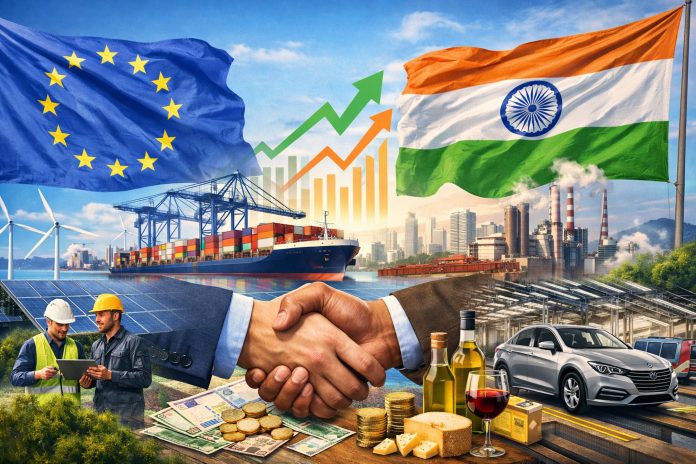
Momentum behind the EU–India trade agreement is increasingly framed as a strategic economic bet rather than a values-led pact. Critics see dilution of environmental ambition, but new data from Austria and fresh signals from Brussels suggest the deal could still deliver growth, jobs and energy resilience—provided sustainability and innovation are operationalised, not deferred.
Recent reporting by Austria’s public broadcaster ORF highlights the domestic economic stakes. Citing analysis by UniCredit Bank Austria, the EU–India pact could generate up to 5,000 industrial jobs in Austria, largely by diversifying supply chains away from overreliance on a narrow set of trading partners and boosting export-oriented manufacturing.
A parallel assessment published by Der Standard estimates potential gains of around €650 million for Austrian industry, with Upper Austria and Styria expected to benefit most. The figures underline how trade policy decisions taken in Brussels translate into highly regionalised economic outcomes within the EU.
At the European level, the political trade-off is clearer. According to Euractiv, Brussels has softened some green requirements to keep negotiations on track. This pragmatic turn reflects India’s importance as a growth market and geopolitical partner, even as it fuels concerns about the EU’s climate credibility.
Yet the agreement is not limited to tariff reductions. Euractiv reports that the two sides plan closer cooperation on startups and research, a channel that could anchor longer-term productivity gains and accelerate the diffusion of clean and digital technologies across both economies.
Sectoral benefits are also becoming more concrete. As outlined by Euractiv, improved market access for cars, wine and olive oil would support European producers facing weak demand at home, while offering India greater product choice and competitive pricing.
Energy policy may ultimately determine whether the deal reinforces or undermines Europe’s strategic goals. Analysis from Euractiv argues that closer trade ties could strengthen supply chains for renewables, hydrogen and critical raw materials—if energy cooperation is explicitly embedded rather than treated as a secondary benefit.
Politically, the scope of the agreement is narrowing to ensure delivery. In an exclusive interview with Euractiv, European Commission President Ursula von der Leyen confirmed that agriculture will be excluded, reducing internal EU resistance and paving the way for a potential signing in New Delhi on 27 January.

