
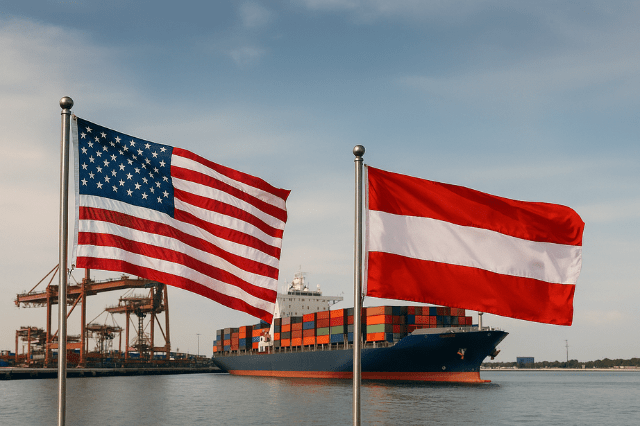
I just came across an update from the Austrian Federal Economic Chamber that stayed with me longer than expected. Not because the facts were surprising, but because they captured the tectonic shifts in global trade with unusual clarity. Predictability—once the backbone of international business—has become scarce. A major driver of this uncertainty resides in Washington.
Since the inauguration of U.S. President Donald J. Trump a year ago, the global trade environment has changed noticeably. U.S. tariff policy has become erratic: sudden announcements, pauses, reversals.
For export-oriented countries like Austria, this is more than an inconvenience. Tariffs are not just a surcharge at the border—they send shockwaves through entire value chains.
What struck me most is how deeply this affects companies that don’t even export directly to the United States. Austria’s direct exports to the U.S. account for 1.7% of GDP—but another 1.4% is tied indirectly to U.S. demand, for example, through German exports that contain Austrian components. Together, that’s 3.1% of Austria’s economic output.
At the same time, trade policy has become a tool of geopolitical power projection. Anyone delivering to the U.S. today must be prepared for the rules to change overnight. This is no longer just an economic issue; it’s a strategic one.
How does a small, highly interconnected export nation like Austria navigate this new reality?
The Chamber highlights three key levers: diversifying risk, checking supply-chain vulnerabilities, and actively exploring opportunities across North America—not just in the U.S., but also in Canada and Mexico.
In 2024, Austria exported €16.2 billion worth of goods to the U.S., plus €2.2 billion to Canada and €2.3 billion to Mexico—each with a trade surplus. High-quality products from machinery, automotive, chemicals, and electronics remain in strong demand. This underscores how well Austrian companies perform in premium segments.
Yet the business climate is cooling. For 2025, a significant drop in U.S.-bound exports is expected—a warning sign that shouldn’t be ignored. That’s precisely why the North America Day hosted by the Chamber matters: a space for exchange, orientation, and concrete action steps. And honestly, platforms like this are more important than ever. Uncertainty can’t be eliminated—but it can be managed with knowledge, networks, and strategic preparation.
Austria is at a point where it needs to rethink its North America strategy—not out of fear, but out of foresight. The region remains economically crucial, and those who diversify early, strengthen supply-chain resilience, and tap into opportunities beyond the U.S. will come out stronger. At the same time, we should acknowledge that geopolitical volatility is here to stay. It’s part of the new normal.
Perhaps that’s the most important insight from the Chamber’s update: stability no longer comes from predictable external conditions, but from the ability to act flexibly, stay informed, and remain globally connected.
If you notice any inaccuracies in my writing, please get in touch with me. I will be happy to correct it.