
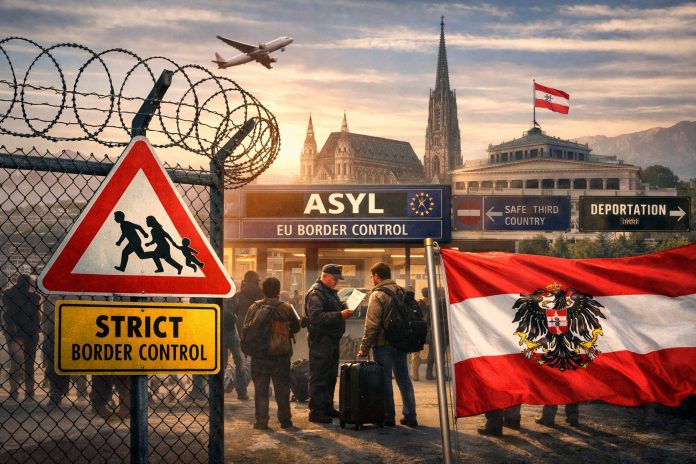
The European Union’s overhaul of the Common European Asylum System (GEAS) marks one of the most significant shifts in migration policy in decades. For Austria — a country shaped by its geography at Europe’s crossroads — the reform is more than a legal adjustment. It is a strategic inflection point. The EU’s new framework promises order, speed, and control over asylum flows, as outlined by the European Parliament’s adoption of the reform package (EU Parliament). But for those who hope to come to Austria — for safety, work, or family — the message is increasingly clear: entry will become harder, slower, and more conditional.
At the EU level, the reform introduces accelerated border procedures, tighter safe third country rules, and stronger mechanisms for returns. The goal is to prevent irregular arrivals from dispersing across Europe before their claims are assessed. In theory, this restores trust in the system and ensures asylum is reserved for those in genuine need. In practice, it reshapes the entire journey.
Austria has emerged as one of the strongest advocates of this harder line. As reported by ORF, Vienna is already moving to extend detention periods for asylum seekers arriving by air and to expand powers for border procedures (ORF – Airport detention). The federal government frames this as “orderly migration”: protection for the vulnerable, but firm limits on uncontrolled entry.
This position is politically potent. Austria has experienced repeated asylum “crises” over the past decade, and public tolerance for ad hoc solutions has waned. The government argues that without credible deterrence, the asylum system collapses under its own weight. Smugglers thrive, municipalities are overwhelmed, and public trust erodes.
Yet implementation is already faltering. Austria’s nine provinces recently refused to endorse a constitutional agreement needed to transpose the EU framework, citing unresolved questions about who bears responsibility for accommodation and integration. This tension reveals a deeper reality: migration policy may be decided in Brussels and Vienna, but its social costs are paid locally.
What This Means for People Who Want to Come to Austria
1. Entry becomes a filtering point, not a gateway
Under GEAS, people arriving irregularly face border procedures that may last weeks, often in closed facilities. Austria is expanding this model at Vienna-Schwechat Airport (ORF). For many, this means never truly “entering” Austria at all. Claims deemed unlikely to succeed can be rejected before applicants reach the interior.
The concept of safe third countries — strengthened in the EU reform (EU Parliament) — allows authorities to redirect applicants to states where they could have sought protection. For migrants, this introduces profound uncertainty: Austria may no longer be the place where one’s story is even heard.
2. Deterrence becomes policy, not rhetoric
Austria openly supports the EU’s shift toward faster returns and external processing. Political leaders emphasize that “not everyone can stay” and that repatriation must become the norm rather than the exception (ORF). For those contemplating Austria as a destination, this dramatically raises the risk of swift removal — particularly for people without airtight protection claims.
3. Legal pathways narrow, not disappear
Austria insists that legal migration remains welcome — especially skilled workers and recognized refugees. But the tone has changed. Family reunification is increasingly framed as something to be limited and managed, not assumed. Quotas, waiting periods, and stricter eligibility rules mean that even lawful routes may stretch over years.
The result is a paradox: Austria still needs workers and acknowledges humanitarian obligations, yet surrounds both with rising procedural barriers.
4. Unequal outcomes become more likely
Austria’s asylum system already produces uneven results. According to national and EU-level analyses, recognition rates and processing times vary sharply by nationality and route of entry (EMN Austria Overview 2024). The new model, with its emphasis on speed and triage, risks deepening these inequalities. Some applicants will be processed rapidly; others may languish in legal limbo.
Researchers warn that this is not merely administrative. The reform represents a structural shift away from individual protection toward system efficiency. The Ludwig Boltzmann Institute describes it as a movement “from pushback to rollback” of asylum norms (GMR analysis).
Austria’s Dilemma
Austria now stands between two imperatives:
- Upholding international protection standards, and
- Restoring public confidence in border control.
The EU reform gives Vienna the tools to prioritize the second. Whether it can preserve the first is an open question.
For people who hope to come to Austria, the future is clear in one respect: the journey will no longer begin with arrival. It will begin with screening, detention, and classification. Those with recognized legal pathways may still succeed, but irregular routes will increasingly end at the border — or far from it.
Austria is not closing itself to the world. But it is redefining what welcome means: no longer a door, but a gate — and one that opens only after the state is satisfied that you truly belong on the other side.
If you notice any inaccuracies in my writing, please get in touch with me. I will be happy to correct it.

