
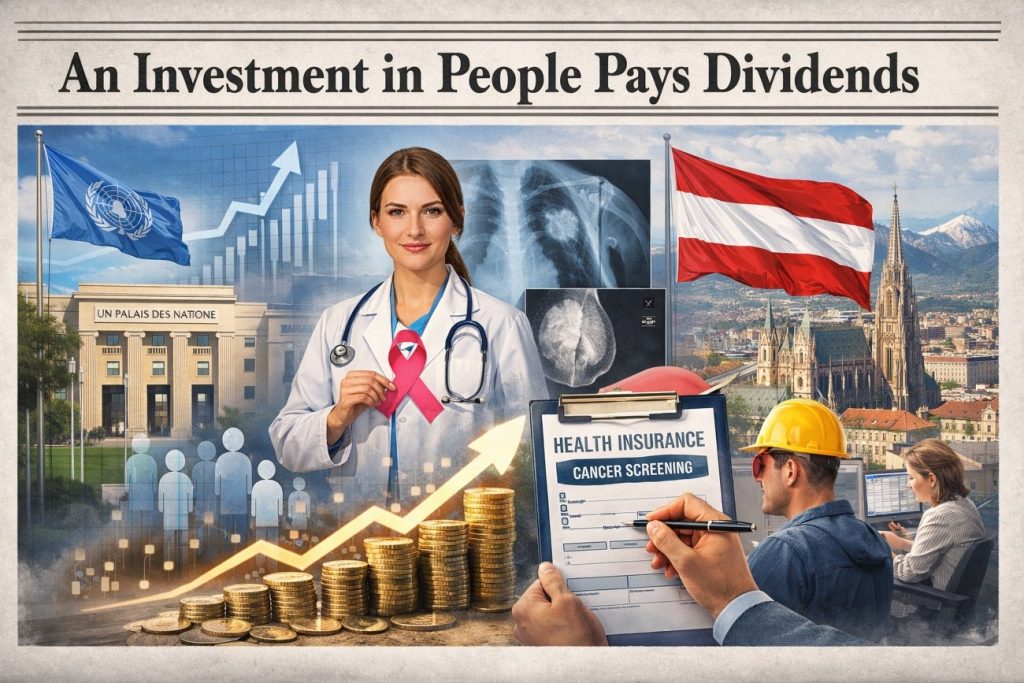
At the United Nations in Geneva this week, leading economists are calling for a fundamental rethink of how we define progress. The “Beyond GDP” initiative, backed by UNCTAD and the UN Secretary-General, argues that gross domestic product tells us little about what truly matters: human wellbeing. As António Guterres put it, moving beyond GDP is essential to “build an economic system that gives value to what counts – human wellbeing – now and in the future, and for everyone.”
Cancer is where that philosophy becomes concrete.
Austria’s latest EU/OECD Cancer Profile shows a country that performs strongly across prevention and care. Incidence and mortality are below the EU average. Organised screening exists. Clinical capacity is high. These are real achievements.
But buried in the same data is a sobering truth: Austria shows one of the largest education-related gaps in breast cancer screening in the EU. People with higher education participate far more than those with lower education. That difference is not abstract. It shapes who is diagnosed early, who faces complex late-stage treatment, and who survives.
If GDP is our only compass, this inequality barely registers. Output can rise while lives quietly diverge. The UN’s “Beyond GDP” warning speaks directly to this problem: there is a growing gap between what statistics say and what people experience. Health is one of the clearest places where that gap becomes visible.
Early detection saves lives. It also saves money. Cancers found at Stage I are cheaper to treat, less disruptive to families, and far less likely to push people out of work. Late diagnoses do the opposite: longer absences, higher disability risk, early labour-market exit, and cascading costs for employers and the state.
This is why workplace insurance and screening should be seen not as perks, but as economic infrastructure.
Universal healthcare does not automatically produce universal access. Time, confidence, health literacy, and friction still decide whether people act. The workplace is one of the few institutions that can overcome those barriers at scale:
- normalising screening as routine, not exceptional;
- removing friction through paid time and simple pathways;
- designing insurance so prevention is default, not buried in fine print;
- communicating in ways that reach people who are currently missing out.
In Austria, the education-linked screening gap is the business case in plain sight. Close it, and you don’t only improve health outcomes. You stabilise careers, protect skills, reduce churn, and lower long-run costs.
The UN economists in Geneva argue that wellbeing, health, and social capital are not “nice to have” — they are drivers of prosperity. Cancer prevention embodies that logic perfectly. A workforce that is diagnosed earlier, treated faster, and supported through recovery is more resilient and more productive. Families experience less shock. Firms face fewer abrupt losses. Public systems carry lighter downstream burdens.
Austria has built a high-performing cancer system. The next step is to make that excellence equitable.
If we take “Beyond GDP” seriously, then success is not only measured in output, but in years of healthy life, in continuity of work, in the absence of avoidable suffering. Workplace insurance and screening sit exactly at that intersection of well-being and productivity.
They are not costs.
They are investments.
And as the data increasingly show, an investment in people pays dividends.
If you notice any inaccuracies in my writing, please get in touch with me. I will be happy to correct it.