
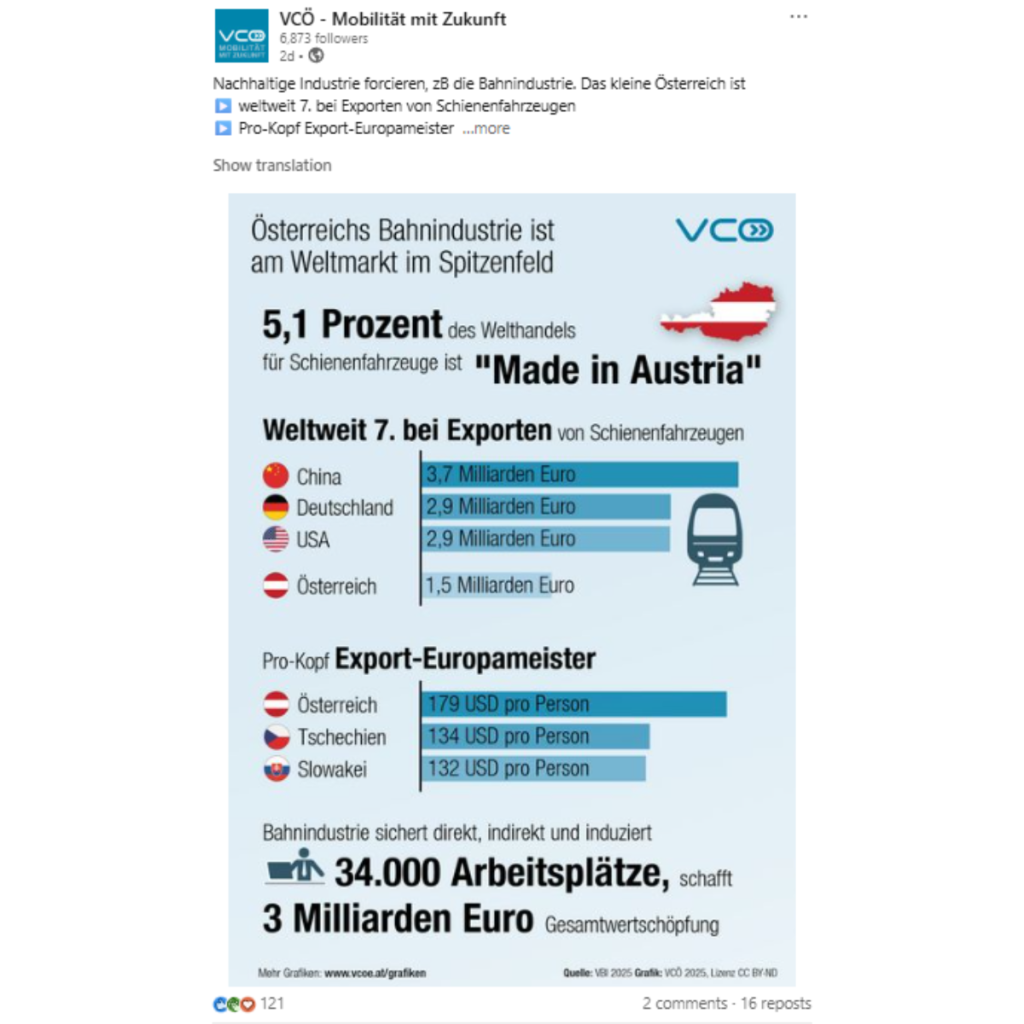
When I came across the infographic on Austria’s railway sector shared by VCÖ – Mobilität mit Zukunft on LinkedIn, I was struck by how impressive—and unexpectedly revealing—it was.

Austria, a country often associated with Alpine beauty, classical music, and Sachertorte, turns out to be a quiet titan in the global railway industry. Let’s unpack the numbers and what they mean, with a few personal thoughts along the way.
The headline stat is striking: 5.1% of global trade in rail vehicles is “Made in Austria.” That’s a huge slice for a country of just under 9 million people. To put it in perspective, Austria ranks 7th worldwide in rail vehicle exports, trailing behind giants like China, Germany, and the U.S.—but still ahead of many larger economies.
| Country | Rail Vehicle Exports (€) |
|---|---|
| China | 3.7 billion |
| Germany | 2.9 billion |
| USA | 2.9 billion |
| Austria | 1.5 billion |
I’ve always admired Austria’s ability to blend tradition with innovation. Seeing it excel in something as industrial and forward-looking as rail technology reinforces that image. It’s not just about Mozart and mountains—it’s about mobility and modernity.
Austria doesn’t just compete in absolute terms—it dominates per capita. With $179 USD in rail exports per person, it outpaces neighbours like the Czech Republic and Slovakia. That’s a testament to how deeply embedded rail manufacturing is in Austria’s economic DNA.
| Country | Per Capita Export (USD) |
|---|---|
| Austria | 179 |
| Czech Republic | 134 |
| Slovakia | 132 |
This stat really caught my eye. It’s easy to overlook smaller countries in global rankings, but per capita metrics reveal the true intensity of specialisation. Austria isn’t just participating—it’s leading.
Economic Backbone: Jobs and Value Creation
The railway industry in Austria supports 34,000 jobs—directly, indirectly, and through induced effects. It also generates €3 billion in total value creation. That’s not just impressive—it’s vital.
In an age where tech startups and digital platforms dominate headlines, it’s refreshing to see a traditional, tangible industry like rail still driving employment and economic growth. Something is grounding about that—literally and figuratively.
So how did Austria become a rail powerhouse?
- Engineering tradition: Austria has a long history of precision engineering and manufacturing excellence.
- Strategic location: Nestled in the heart of Europe, Austria is a natural hub for rail logistics and transit.
- Sustainability focus: Rail is one of the greenest transport modes, and Austria’s environmental policies align well with this sector.
- Global players: Companies like Siemens Mobility (with major operations in Austria) and Plasser & Theurer (a world leader in track maintenance machines) anchor the industry.
Austria’s railway success story is a reminder that innovation doesn’t always come with flashy headlines. Sometimes, it’s about quiet excellence, sustained investment, and a deep-rooted commitment to quality. Whether you’re a policymaker, a student of economics, or just someone who loves trains (like me!), there’s a lot to admire here.
Next time I ride a train in Europe, I’ll be wondering if it was built—or at least influenced—by Austrian hands. And that’s a pretty cool thought.
If you notice any inaccuracies in my writing, please get in touch with me. I will be happy to correct it.